Aviation Insights · Pharmaceutical Logistics
The global pharmaceutical industry is undergoing a biological revolution. The rise of mRNA vaccines, monoclonal antibodies, and advanced biologics has transformed modern medicine. However, these life-saving therapeutics are highly sensitive to temperature fluctuations. A deviation of just a few degrees can irreversibly degrade the efficacy of a multi-million dollar shipment. As biopharma demand grows, maintaining the unbroken cold chain is vital. Air cargo charter provides the fastest, most controlled environment for pharma logistics, bypassing the vulnerabilities of commercial freight networks.
Cold chain logistics is the transport and storage of temperature-sensitive products along an unbroken, documented supply chain. In aviation pharma logistics, cargo must be maintained within strictly controlled temperature bands, typically:
The danger lies in the "temperature excursion." If a shipment of vaccines sits on a hot tarmac in Dubai or Singapore for 45 minutes, the internal temperature can breach the +8°C threshold. Once proteins denature due to heat, they cannot be reconstituted. The entire shipment must be destroyed, resulting in catastrophic financial loss and, more importantly, a delay in life-saving medication reaching patients.
To combat temperature excursions, pharmaceutical shippers utilize two primary types of air cargo containers: passive and active.
Passive Systems (e.g., Csafe RKN): These rely on phase-change materials (PCM) or dry ice, enclosed within heavy thermal insulation panels. They do not require an external power source. While cost-effective for short regional hops, they have a finite cooling capacity. Once the dry ice sublimates or the PCM warms up, the container loses its protective envelope. They are also heavy, eating into the aircraft's payload capacity.
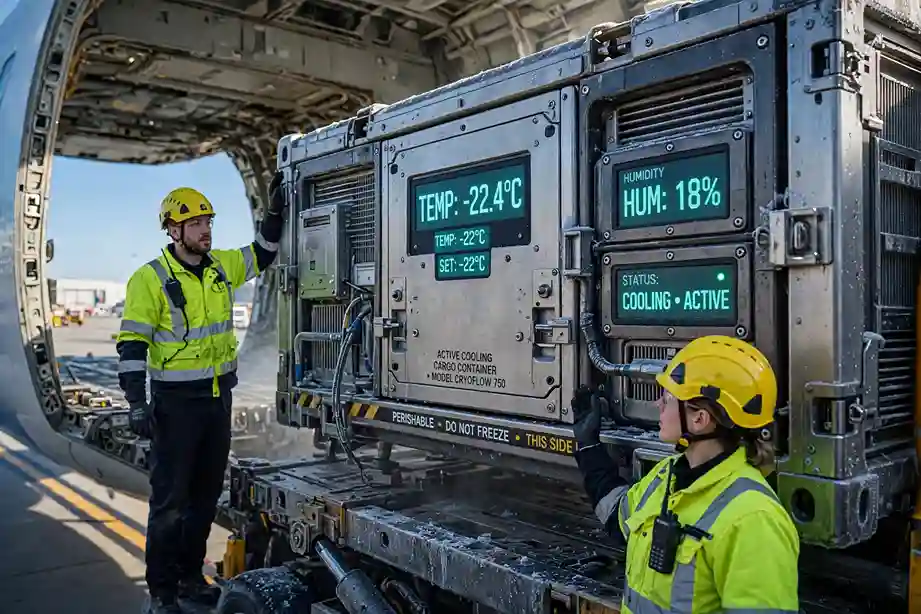
Active Systems (e.g., Envirotainer RAP e2): These are the gold standard for international cold chain logistics. Active containers are essentially self-contained refrigerators with their own battery-powered compressor system. They feature real-time temperature and humidity dataloggers. More importantly, they can be plugged directly into the aircraft's main deck power supply (110V/220V), ensuring the compressor runs continuously during the flight. They can maintain a +2°C to +8°C environment for days, regardless of external ambient temperatures.
Commercial passenger and cargo airlines route freight through massive, automated hub-and-spoke systems. A shipment of pharma flying from Mumbai to London might transit through Dubai or Frankfurt. At these mega-hubs, cargo is offloaded from one aircraft, moved by tug to a warehouse, sorted, and then reloaded onto another aircraft.
This "tarmac exposure time" is the Achilles' heel of commercial pharma logistics. Even if the container is active, a 4-hour delay on the tarmac waiting for customs clearance can drain the battery below safe levels. Furthermore, commercial freight networks prioritize high-volume e-commerce mail and general cargo; they cannot prioritize a single pharma pallet without massive surcharges. When supply chains demand urgency, commercial freight fails to deliver.
For high-volume, high-value, or time-critical pharmaceutical shipments, a dedicated cargo aircraft charter is the ultimate safeguard. By chartering a freighter (such as a Boeing 777F or A330-200F), pharma companies take complete control of the supply chain.
As an independent aircraft charter broker, Skylinks Asia is your strategic partner in life-saving logistics. We do not own aircraft or containers; we manage the intelligence. We know exactly which licensed AOC holders across Asia, the Middle East, and Africa operate freighters equipped with active cooling infrastructure.
We handle the sourcing of the aircraft, the negotiation of charter rates, the acquisition of overflight permits, and the coordination of GDP-compliant ground handling. From the moment your pharmaceutical cargo leaves the cold storage warehouse to the moment it touches down at its destination, our team ensures an unbroken, zero-blur, fully transparent cold chain. Because when the cargo is a life-saving vaccine, failure is not an option.
Our 24/7 operations team is ready to source the nearest GDP-compliant freighter for your critical cargo. Contact us today.
Contact Our Charter Desk