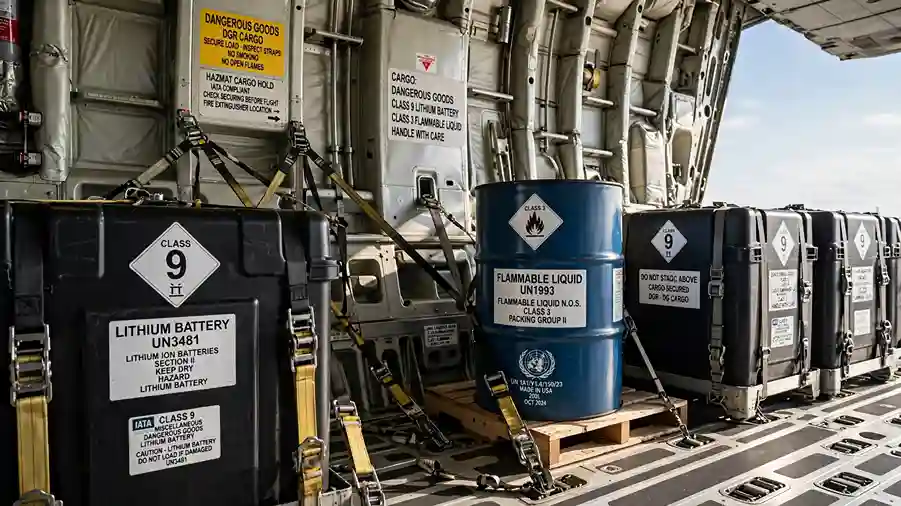
When commercial airlines refuse your cargo, Skylinks Asia Aviation provides the solution. We charter dedicated freighters qualified to transport dangerous goods, explosives, and hazmat safely across Asia, the Middle East & Africa.
By the Skylinks Asia Charter Desk · Reviewed by our Operations Team
Transporting hazardous materials by air requires rigorous compliance with IATA Dangerous Goods Regulations (DGR). We work only with certified cargo operators and ground handlers who are explicitly approved to carry specific DG classes. From Class 1 explosives for the mining sector to Class 9 lithium batteries for EV manufacturers, we ensure your cargo is documented, packed, and loaded with zero compromises on safety.
Dangerous goods (DGR) charter moves cargo that scheduled passenger airlines often can't or won't carry — explosives, flammable chemicals, corrosives, and Class 9 items like lithium-ion batteries — using IATA-certified freighters, trained handling staff, and the specific documentation (a Shipper's Declaration for Dangerous Goods and Air Waybill) every DG shipment requires.
Every DG shipment carries requirements standard freight doesn't, regardless of aircraft type.
A Shipper's Declaration for Dangerous Goods (DGD) and a properly completed Air Waybill are required for most classes, specifying the UN number, proper shipping name, hazard class, and packing group.
Packaging must carry UN specification markings and pass performance testing — stacking, vibration, drop, and pressure — appropriate to the hazard class and quantity being shipped.
IATA mandates recurrent dangerous goods training for handling staff on a fixed cycle, not a one-time certification — a detail worth confirming with any operator or handler before booking.
Not every cargo operator is approved to carry every DG class. A charter broker's job includes confirming the specific aircraft and operator hold approval for your cargo's classification, not just general cargo capability.
| Class | Category | Common Examples |
|---|---|---|
| 1 | Explosives | Detonators, blasting caps, mining explosives, fireworks |
| 2 | Gases | Compressed, liquefied, or dissolved gases (flammable, toxic, or non-toxic) |
| 3 | Flammable liquids | Industrial solvents, fuels, resins |
| 4 | Flammable solids | Certain metals, self-reactive substances |
| 5 | Oxidizers & organic peroxides | Industrial oxidizing agents |
| 6 | Toxic & infectious substances | Certain chemicals, medical/biological samples |
| 7 | Radioactive material | Medical isotopes, industrial radioactive sources |
| 8 | Corrosives | Acids, industrial cleaning agents |
| 9 | Miscellaneous | Lithium-ion and lithium metal batteries, dry ice, magnetized material |
Several of these hazard classes carry Cargo Aircraft Only restrictions depending on quantity and packaging. To understand exactly which dangerous goods are legally barred from passenger aircraft and require CAO charter, see our comprehensive companion guide.
VIEW CAO CHARTER GUIDEClass 3 flammable liquids, Class 8 corrosives, and Class 5 oxidizers. We arrange dedicated cargo flights for chemical manufacturers moving industrial solvents, resins, and acids globally.
Oil & Gas Equipment TransportClass 9 lithium-ion batteries pose severe fire risks on passenger aircraft. We source freighters for EV manufacturers and tech firms to transport bulk batteries safely and compliantly.
Moving detonators, blasting caps, or mining explosives requires specialized security and segregation. We coordinate highly secure charter flights for defense and mining logistics clients.
Understand exactly which dangerous goods are legally barred from passenger aircraft and require Cargo Aircraft Only (CAO) charter under stricter packaging and labeling rules.
A comprehensive guide on the IATA regulations, packaging requirements, and operational considerations for safely transporting Class 9 lithium-ion batteries by air.
Precision and documentation are critical for dangerous goods. Provide your DG Class and UN Number, and our team will source appropriately certified freighters and ground handlers.
Our DGR desk handles dangerous goods cargo enquiries through our secure contact form. Include origin and destination airports, DG class, UN number, packing group, weight or volume, and required date so we can source appropriately certified aircraft and ground handlers without delay.
Your information is treated as confidential.
The IATA Dangerous Goods Regulations (DGR) is the global standard governing how hazardous materials are classified, packaged, documented, and handled for air transport. Charter operators and ground handlers must be specifically approved to carry the DG class in question — general cargo capability isn't enough.
Most DG shipments require a Shipper's Declaration for Dangerous Goods (DGD) and a properly completed Air Waybill, specifying the UN number, proper shipping name, hazard class, and packing group. Some smaller, limited-quantity shipments have reduced documentation requirements.
Passenger airlines carry strict quantity and packaging limits for DG cargo, and some classes or quantities are barred from passenger aircraft entirely for safety reasons, regardless of how well they're packaged. A dedicated cargo charter often remains the only legal option for these shipments.
DG charter covers any hazardous shipment moved by dedicated freighter. CAO is a specific designation for shipments that are legally barred from passenger aircraft but still permitted on cargo aircraft under stricter packaging and labeling rules — see our detailed CAO guide for which classes this applies to.
Some can, under strict conditions — most explosives divisions are either forbidden outright or restricted to Cargo Aircraft Only, with specialized security, segregation, and often government authorization required. Only a narrow subset is permitted on passenger aircraft at all.
Packaging must carry UN specification markings and meet performance standards — drop, stacking, vibration, and pressure testing — appropriate to the hazard class, packing group, and quantity. Combination packaging with inner receptacles and outer packaging is common for chemicals and liquids.
Standard DG shipments typically need a few days' lead time to confirm operator approval, permits, and ground handling for the specific hazard class. Genuinely urgent DG shipments can be prioritized — see our urgent cargo charter page for how emergency dispatch works.
Yes. Operators and ground handling staff must hold specific approvals for the DG classes they carry, and IATA requires recurrent dangerous goods training for handling personnel on a fixed cycle rather than a one-time qualification.