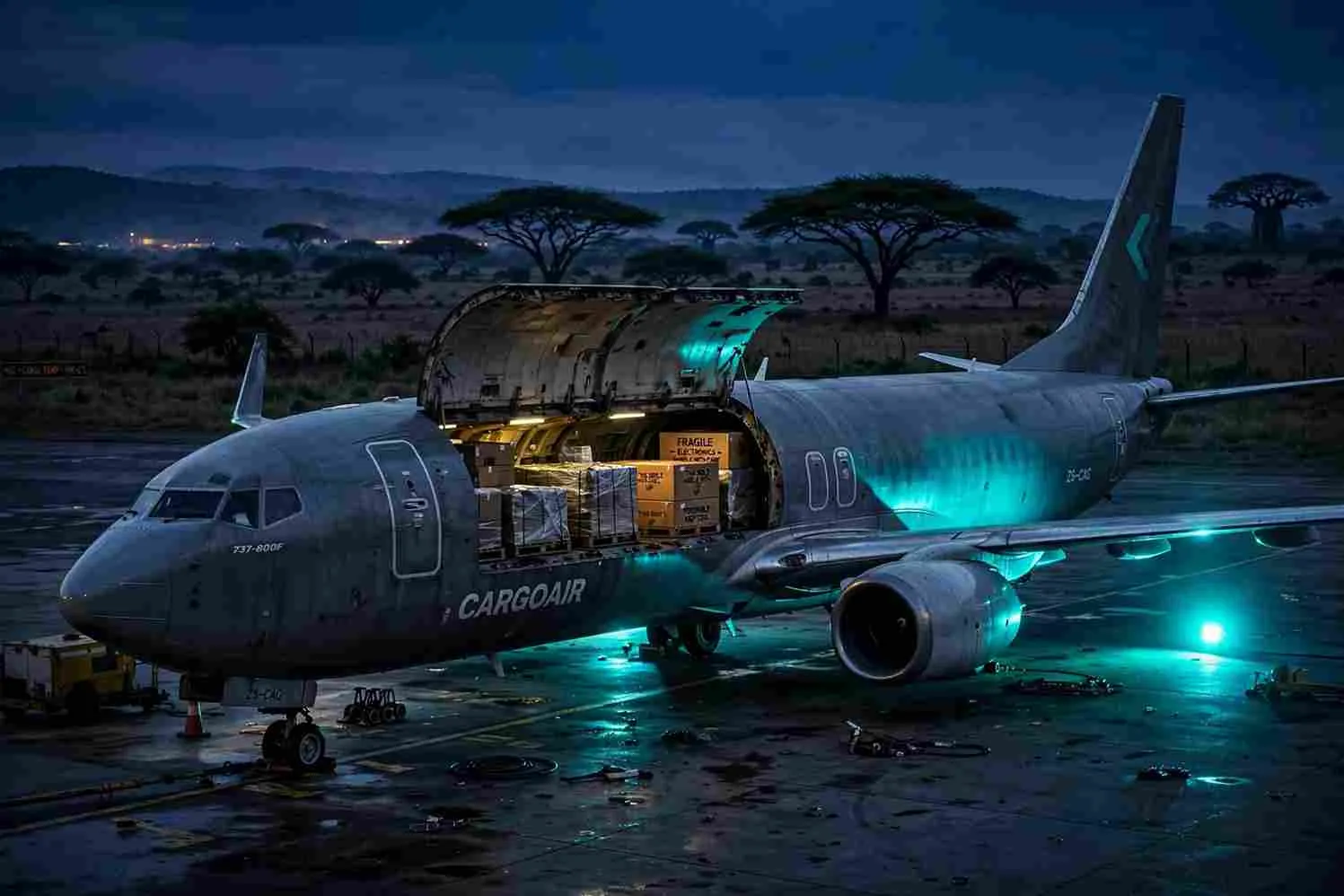
Ask anyone who has ever had to move a transformer, a field hospital, a Formula 1 garage, or a container of perishables against an impossible deadline, and they'll tell you the same thing: scheduled air freight is great — until it isn't. That's the moment a cargo aircraft charter stops being a "nice to have" and becomes the only realistic option on the table.
This guide walks through how freighter aircraft are built, which models actually show up on the charter market, which industries lean on charter capacity the most, and — because geography changes everything in this business — what charter buyers across Asia, Africa, and the Middle East should know before they pick up the phone.
Why Charter a Freighter in the First Place?
Booking space on a scheduled freighter or the belly hold of a passenger flight works fine when your cargo is patient. A charter earns its premium the moment your shipment isn't.
- You control the schedule, not the airline. A chartered aircraft flies when your cargo is ready, not when a published timetable says so — a big deal for urgent cargo charter Asia routes where a single delayed connection can blow a production line.
- You can move things scheduled carriers simply can't. Generators, yachts, wind turbine blades, drilling equipment — none of that fits through a standard cargo door. This is where outsize cargo charter services and AN-124 charter for heavy equipment searches start climbing.
- You skip the consolidation game. No co-loading, no waiting for a flight to fill, no risk of your pallet getting bumped for a higher-paying shipper.
- You get point-to-point routing. Charters can fly direct into airports scheduled freighters never touch — a genuine advantage for project cargo charter Middle East to Africa moves, where the destination is often a mine site, a drilling pad, or an exhibition ground, not a major hub.
- You gain flexibility on documentation and customs. A dedicated charter operator can plan customs pre-clearance, carnet handling, ministry approvals, and ground handling around your cargo specifically, rather than fitting into someone else's process.
Which Industries Actually Rely on Cargo Charter?
Air charter is often framed as an emergency-only tool, but in practice a wide range of industries build it into their regular planning cycle. A quick look at who's booking, and why:
- Exhibitions and events. Trade show stands, sports and motorsport equipment, concert staging, and museum touring exhibits all move on tight, non-negotiable dates. Exhibition logistics air charter and event cargo charter Middle East are recurring needs for organizers moving booths and equipment between Dubai, European, and Asian exhibition calendars — often on a round-trip basis with a hard return deadline.
- Automotive. From just-in-time components keeping an assembly line running to complete vehicles and motorsport cars headed to a race weekend, the sector depends on automotive parts charter Asia and just-in-time component air charter to avoid production stoppages that cost far more than the flight itself.
- Aerospace. AOG (Aircraft-On-Ground) situations are the classic aerospace charter trigger — a grounded commercial aircraft losing revenue by the hour until a critical part arrives. AOG charter services Middle East and aerospace component charter Asia sit firmly in urgent, premium-rate territory.
- Oil & Gas. Drilling equipment, valves, subsea components, and entire modular units for remote rigs and refineries move via charter when a project timeline can't absorb sea-freight lead times. Oil and gas project cargo charter West Africa and rig equipment air charter Middle East are strong, comparatively low-competition search terms in this space.
- Humanitarian aid and disaster relief. NGOs and government agencies rely on charter capacity to get tents, medical supplies, and food aid into airstrips scheduled carriers don't serve. Humanitarian aid air charter Africa and disaster relief cargo charter South Asia reflect a market where speed genuinely saves lives.
- Pharmaceuticals and healthcare. Vaccines, blood products, and clinical trial materials need temperature-controlled, time-critical movement — pharma cargo charter Middle East and medical supplies air charter Africa are consistent demand drivers, especially into markets with limited cold-chain infrastructure.
- Mining and heavy industry. Excavators, crushers, and processing equipment bound for remote sites push demand for mining equipment air charter Africa and heavy machinery charter Central Asia, where road access is seasonal or nonexistent.
- Renewable energy. Wind turbine blades, nacelles, and solar components are awkward, oversized loads that increasingly turn up in outsize cargo charter Middle East and renewable energy project charter Africa conversations as the region's clean energy build-out accelerates.
- Fashion, retail, and e-commerce. Seasonal collections and high-value peak-season inventory sometimes can't wait for scheduled freight allocation, driving occasional but high-value retail peak season air charter Asia bookings.
- Live animals and livestock. Breeding stock, racehorses, and zoo transfers require specialized handling that only a small pool of operators can provide — a niche but consistent slice of the live animal charter Middle East market.
The Three Broad Categories of Freighter Aircraft
Every cargo aircraft on the market today falls, roughly, into one of three buckets. Knowing which one your shipment needs is the first question any charter broker will ask.
1. Narrow-Body / Regional Freighters
Converted from single-aisle passenger jets — think Boeing 737 or Airbus A320 family conversions — these aircraft handle shorter regional hops with quick turnaround times. They're the workhorses behind e-commerce cargo charter East Africa, spare parts runs, and mail contracts, and their smaller footprint means they can land at secondary airports with shorter runways that a wide-body simply can't use. If you're moving urgent automotive parts between, say, Nairobi and Dar es Salaam, or hopping exhibition freight around the GCC, this is usually the class of aircraft doing the work.
2. Wide-Body Freighters
This is the segment that keeps global trade moving. Wide-bodies carry serious tonnage over intercontinental distances and frequently come with temperature-controlled compartments, making them the default choice for pharma cargo charter Middle East and perishable goods air charter Asia — flowers out of Nairobi, seafood out of Southeast Asia, vaccines into landlocked African states. Aircraft in this class also handle heavier industrial freight: automotive and aerospace components, oil and gas equipment, and bulk consumer goods bound for fast-growing retail markets.
3. Outsize / Heavy-Lift Freighters
When cargo is too big, too heavy, or too oddly shaped for anything else, this is the category that gets the call. Reinforced floors, nose- or front-loading doors, and enormous internal volumes let these aircraft swallow entire pieces of industrial plant. They're the backbone of humanitarian aid air charter Africa operations, oil and gas project cargo charter Middle East, and disaster-relief logistics — anywhere a runway is short, unpaved, or simply the only option nearby.
What Actually Makes a Cargo Aircraft "Cargo"
A few structural traits separate a purpose-built freighter (or a well-executed conversion) from a passenger jet with the seats pulled out:
- Oversized cargo doors — often nose-loading or upward-swinging side doors — built for pallets and containers, not passengers.
- Reinforced, roller-equipped flooring that lets ground crews slide heavy pallets into position without a forest of forklifts.
- Pressurized, climate-controlled holds for pharmaceuticals, live animals, and perishables that can't survive a standard unpressurized belly compartment.
- Payload-optimized range — freighters are tuned for maximum tonnage per mile rather than passenger comfort, which is exactly why charter economics can beat scheduled freight on long, heavy routes.
- Modular interiors that let an operator reconfigure the cabin for palletized cargo one week, exhibition stands the next, and oversized machinery after that.
- Modern tracking and comms systems, which matter enormously to shippers who need real-time visibility on high-value or time-critical freight — a growing ask from clients running time-critical air charter Asia Pacific operations.
The Aircraft You'll Actually See on the Charter Market
Not every model built ever gets chartered commercially. Here's what shows up most often when you're sourcing a charter quote, and where each one tends to earn its keep.
- Antonov AN-124 Ruslan — Still the go-to name in heavy-lift charter services worldwide. Its drive-on/drive-off front-loading ramp makes it a favorite for generators, mining trucks, and satellite components, and it remains one of the most searched aircraft for oversized cargo charter Middle East to Central Asia corridors.
- Ilyushin IL-76 — A rugged, short-field performer that can land on gravel or semi-prepared strips most jets can't touch. It's a recurring name in IL-76 charter Africa and humanitarian cargo charter Central Asia conversations, particularly for relief flights into airstrips with limited infrastructure.
- Boeing 747-8F / 747-400F — The nose-loading door is the headline feature, letting it swallow cargo that would never fit through a side door. A long-haul staple for Boeing 747 freighter charter UAE and Gulf-to-Asia trade lanes, and a common choice for large exhibition and automotive shipments.
- Boeing 777F — Newer, longer-range, and notably fuel-efficient, which keeps operating costs — and therefore charter rates — more competitive on ultra-long routes between the Middle East, East Asia, and Africa.
- Airbus A330-200F — A strong middle-distance option and increasingly common in wide-body cargo charter Africa quotes, especially where full 747-class capacity isn't needed but wide-body volume is.
- Boeing 757-200F and 767-300F — Popular for regional and medium-haul work; both can access airports with shorter or more restrictive runways, which matters for secondary airport cargo charter Asia routes serving smaller industrial hubs and exhibition cities.
- Lockheed L-100 (Hercules) — The aircraft charter brokers reach for when the destination airstrip barely qualifies as one. Short takeoff and landing capability makes it a mainstay of remote area cargo charter Africa and disaster-response logistics.
- McDonnell Douglas MD-11F — Out of production but still flying long-haul freight reliably, often turning up in ACMI cargo charter fleets serving Asia–Middle East lanes.
Regional Notes: Chartering Cargo Aircraft in Asia, Africa, and the Middle East
Asia. The region's charter demand splits several ways: high-frequency, time-critical electronics and e-commerce freight moving between manufacturing hubs; automotive and aerospace components keeping factories running; and heavy-lift charters serving energy and infrastructure projects further inland. Searches like cargo charter rates China to Middle East, same-day air charter Southeast Asia, and semiconductor cargo charter Asia reflect just how deadline-driven this market has become.
Africa. Infrastructure gaps make chartered freighters less of a luxury and more of a lifeline — mining, oil and gas, humanitarian, and agricultural sectors all lean heavily on charter capacity to reach airstrips that scheduled carriers never will. Expect strong, low-competition demand around terms like mining equipment air charter Africa, NGO relief flight charter East Africa, and oil and gas project cargo charter West Africa.
Middle East. With Dubai, Abu Dhabi, and Doha functioning as global freight crossroads, the Gulf is less an end destination and more a launchpad — a natural hub for onward charters into Africa, South Asia, and the CIS, and a major staging point for regional exhibitions and events. Keywords worth building content around include cargo aircraft charter Dubai, freighter charter UAE to Africa, exhibition cargo charter Dubai, and GCC project cargo charter services, all of which see meaningful search interest with comparatively low competition.
Choosing the Right Aircraft for Your Charter
A good charter broker will ask about more than just weight and dimensions. The real questions are: How urgent is the deadline? Does the cargo need climate control? What's the runway condition at both ends? Is this a one-off move — a single exhibition stand or an AOG part — or the first of several project cargo flights? Answering those honestly, before you start requesting quotes, is what separates a smooth charter booking from a scramble.
Final Word
Cargo aircraft, from nimble regional freighters to Antonov-class heavy-lifters, exist because global trade — and the industries that depend on it, from exhibitions and automotive to oil & gas and humanitarian relief — refuses to wait. Chartering one is, at its core, a bet that speed, flexibility, and direct routing are worth paying for. Whether you're moving a single grounded aircraft part, an exhibition stand, a rig component, or coordinating relief flights into a disaster zone, understanding the aircraft options — and the regional and industry dynamics that shape availability and pricing — puts you in a far stronger position at the negotiating table.