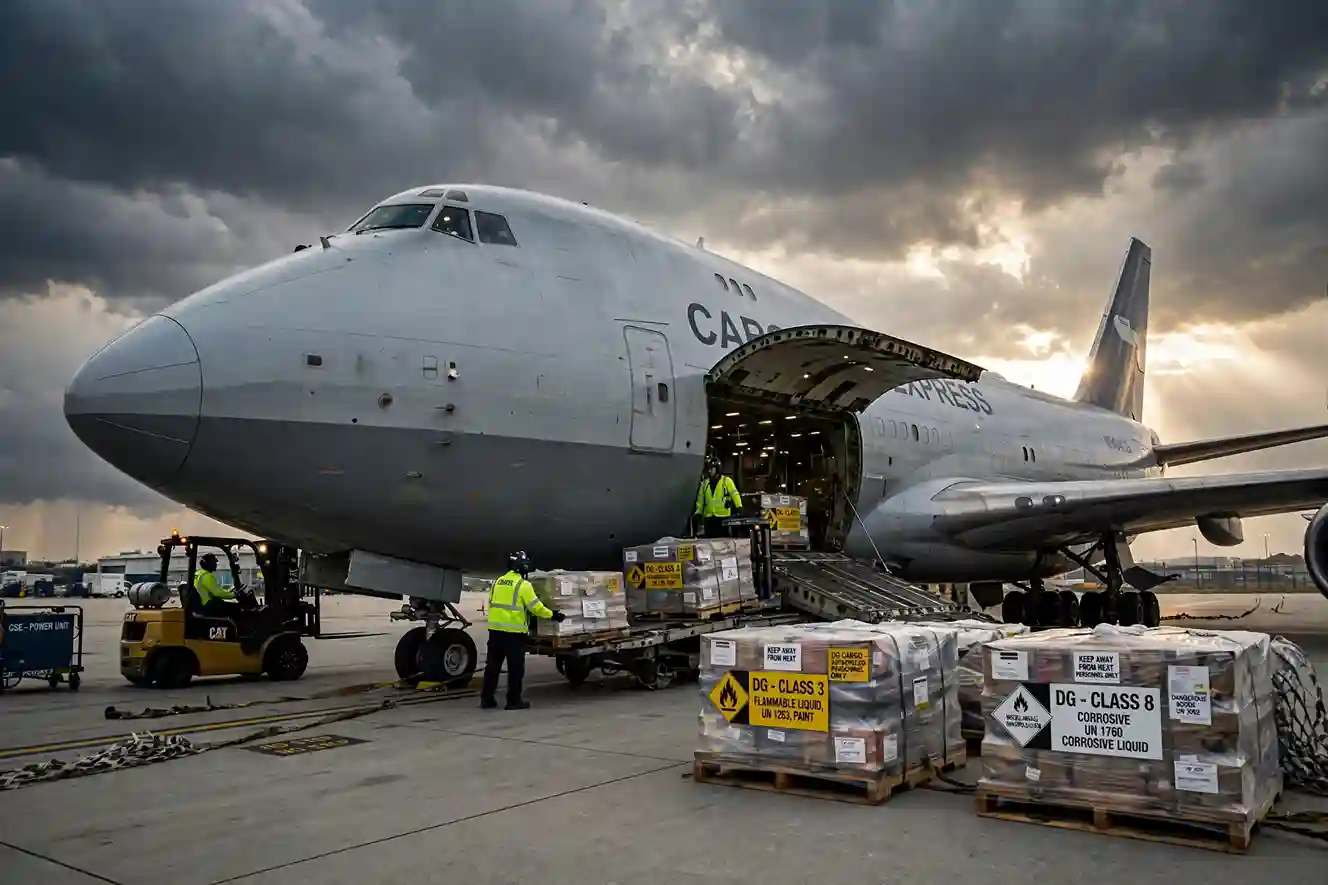
Quick answer: A dangerous goods shipment must go Cargo Aircraft Only (CAO) whenever its packing instruction or quantity is permitted under the cargo-aircraft columns of the IATA DGR's List of Dangerous Goods but is either forbidden or more restricted under the passenger-aircraft columns. In practice, this most often applies to lithium metal batteries and larger lithium-ion shipments, most Class 1 explosives, higher-activity radioactive material, Category A infectious substances, and flammable liquids, oxidizers, or corrosives shipped above passenger-aircraft quantity limits.
Our earlier post on lithium battery shipping covered one specific, high-volume example of CAO-restricted cargo. But lithium batteries are a single entry in a much longer list. If you're shipping dangerous goods regularly, it's worth understanding the pattern behind why something ends up CAO-only — because it changes your routing options, your lead time, and, often, whether a scheduled carrier can take the shipment at all.
What "Cargo Aircraft Only" Actually Means
The IATA Dangerous Goods Regulations lay out permitted packing instructions and quantity limits in parallel columns for passenger aircraft and cargo aircraft. When a package's contents exceed the passenger-aircraft limit, or when the passenger-aircraft column is marked "Forbidden" outright, the shipment can often still move — but only aboard a dedicated freighter, under stricter packaging rules, and carrying the rectangular orange CAO label.
This is a distinct category from goods that are forbidden on all aircraft, passenger and cargo alike. CAO status means there's still a legal pathway to ship by air — it just runs through cargo capacity rather than belly-hold space on a scheduled passenger route. That distinction matters commercially: it's the difference between "we need a different carrier" and "this can only move on a freighter, and if none is scheduled on your lane, you need charter."
The Categories Most Likely to Land on CAO
- Lithium batteries (Class 9). Covered in depth in our previous post — in short, lithium metal batteries (UN3090) and higher-capacity or unpackaged lithium-ion batteries (UN3480) are barred from passenger aircraft and must move CAO, with strict state-of-charge, UN38.3 testing, and drop-test packaging requirements.
- Explosives (Class 1). Most explosives divisions are either forbidden entirely or restricted to CAO; only a narrow subset (Division 1.4S) is generally permitted on passenger aircraft. Anything outside that narrow exception is a freighter-only conversation from the start.
- Radioactive materials (Class 7). Higher-activity radioactive shipments, Type B packages, and fissile-material shipments typically exceed what's allowed on passenger aircraft and route CAO. Lower-activity medical isotopes, by contrast, often move under looser passenger-aircraft limits — the activity level and packaging type is what decides it, not the fact that it's "radioactive" in general.
- Infectious substances, Category A (Class 6.2). The highest-risk infectious substances — those capable of causing permanent disability or fatal disease in otherwise healthy humans or animals — are frequently restricted to CAO because passenger-aircraft quantity allowances are minimal or nonexistent for this category.
- Flammable liquids, oxidizers, and corrosives (Classes 3, 5.1, 8) above passenger limits. These are the categories where CAO status often comes down to quantity rather than substance. A drum or IBC-sized container of an industrial solvent, oxidizing agent, or corrosive chemical will frequently exceed passenger-aircraft packing limits even when a smaller inner packaging of the exact same substance is permitted on a passenger flight.
- Certain compressed and toxic gases (Class 2). Toxic or flammable gases in cylinder sizes beyond passenger-aircraft allowances, or gases classified in the highest toxicity subdivisions, generally require CAO handling.
Why This Is a Charter Conversation, Not Just a Compliance One
Knowing a shipment is CAO-only answers the regulatory question. It doesn't answer the logistics one — and that's usually where the real time pressure shows up:
- Scheduled freighter space isn't guaranteed on every lane. A shipper with a CAO-only consignment on a route with no scheduled freighter service is stuck regardless of how correct their paperwork is.
- Consolidation cargo means dependency on someone else's schedule. Booking DG freight through a scheduled carrier's cargo hold means waiting for their next rotation, their space availability, and their acceptance of your specific UN number that week.
- Mixed-compatibility limits apply per aircraft, not per shipment. A freighter carrying other CAO cargo may already be at its compatible-DG capacity for your hazard class, even if there's physical space left.
- Charter removes the scheduling variable. A dedicated dangerous goods charter puts the aircraft, routing, and DG-compatible loading plan entirely under your timeline rather than a carrier's weekly rotation.
What to Have Ready Before You Call a Charter Desk
- UN number and proper shipping name for every item in the consignment
- Packing group and hazard class/division
- Quantity per package and total shipment quantity
- Whether packages are marked/labeled CAO already, or need classification review
- Any special certificates (UN38.3 for batteries, Type B package certification for radioactive material, etc.)
A DG-experienced broker will cross-check all of this against the current IATA DGR edition before quoting — regulations are updated annually, and a shipment that was CAO-eligible last year can shift categories with a new edition.