Aviation Insights · Heavy Cargo Logistics
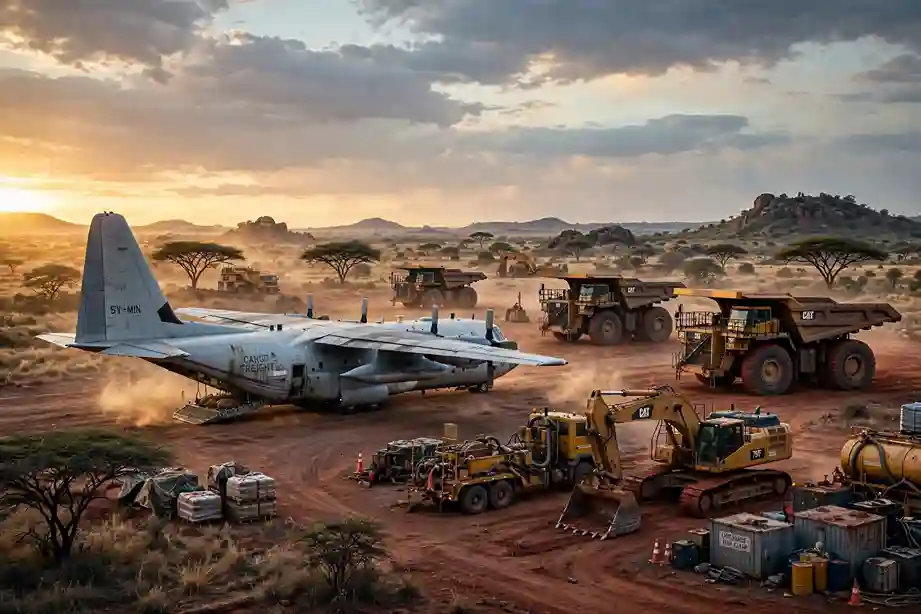
Africa is the world’s richest continent in mineral resources, holding vast reserves of cobalt, copper, diamonds, and gold. Yet, the infrastructure to extract and transport these resources is often non-existent. Moving a 30-ton Caterpillar excavator or a massive mine-duty truck to a remote site in the bush cannot be done by road—there are no roads. This is where heavy cargo air charter becomes the absolute lifeline of the African mining industry. But flying into these remote, unimproved dirt strips requires specialized ramp-loading aircraft, expert permits, and deep logistical intelligence.
Commercial Boeing or Airbus freighters are useless in African mining logistics. They require 3,000 meters of pristine, paved concrete. Mining airstrips are often 1,200 to 1,600 meters of compacted red dirt, gravel, or laterite. Therefore, operators must utilize specialized ramp-loading turboprop aircraft designed for rough terrain.
A critical metric in mining logistics is the California Bearing Ratio (CBR), which measures the strength of the soil. Before any charter broker commits an aircraft to a remote strip, they must verify the CBR. If the dirt is too soft, a 70-ton Il-76 will simply sink into the mud upon landing, creating a multi-million dollar recovery nightmare.
Dust is another severe hazard. During the dry season, the prop wash of a heavy turboprop creates blinding dust storms that can reduce visibility to zero, making the landing roll dangerous and necessitating special mitigation techniques like watering the strip before arrival. Furthermore, dust ingestion can destroy jet engines, which is why pure turboprops are heavily favored for these routes.
While we protect the confidentiality of our clients' private mine strips, the African continent features several notorious public and semi-public airstrips where heavy air charter is a daily routine:
Orchestrating a heavy cargo charter into a remote African dirt strip is not a point-and-click operation. It requires an independent broker who understands the exact load-bearing capacity of the soil, the turnaround time for ground equipment, and the complex web of overflight and diplomatic clearances required to cross African airspace.
At Skylinks Asia, we act as your logistical intelligence layer. We verify the runway data, source licensed AOC holders whose aircraft are rated for unpaved strips, and coordinate the fuel logistics (often flying in Jet A1 drums if local supply is compromised). From the copper belts of the DRC to the diamond fields of Sierra Leone, we ensure your mining equipment reaches the bush safely, efficiently, and with zero-blur transparency.
If your mining operation requires heavy lift to a remote dirt strip, our cargo specialists can source the exact right aircraft. Contact us today.
Contact Our Charter Desk