Quick answer: Central Asia's landlocked republics have no direct sea access, and the overland rail corridors meant to connect them to South Asian and Gulf ports through Afghanistan — the Trans-Afghan Railway chief among them — remain years from completion, with only a small fraction of the planned network actually operating today. When the Pakistan-Afghanistan land border closed in October 2025, disrupting overland trade, the practical response wasn't to wait for the railway — it was reactivating scheduled air freight corridors, including the Kabul-Delhi and Kabul-Amritsar routes, within months. That pattern is the core reason air cargo remains the dependable option for this region: it doesn't require the infrastructure, cross-border political alignment, or construction timeline that overland corridors do.
The Overland Megaprojects Are Still Years Away
The most-discussed solution to Central Asia's landlocked trade problem is the Trans-Afghan Railway — a trilateral project between Uzbekistan, Afghanistan, and Pakistan spanning approximately 573 kilometers, intended to connect Termez (Uzbekistan) with Mazar-i-Sharif and Logar (Afghanistan) and extending to Kharlachi (Pakistan). Once complete, the corridor is projected to handle up to 20 million tonnes of freight annually and cut cargo delivery times between Uzbekistan and Pakistan by around five days.
The ambition is real, but the cost has risen sharply. Uzbekistan's Transport Ministry now estimates the project could exceed $7 billion — up from an initial $4.8 billion estimate — with a feasibility study due by the end of 2026 and construction potentially beginning in the second half of 2027. In January 2026, Kazakhstan's government offered to fully finance a connecting line to Pakistani ports via Afghanistan.
What's actually running today is far more modest. The only operational rail segment inside Afghanistan on this route is the Hairatan-Mazar-i-Sharif line — a 75-kilometer link that's been running since 2011, connecting to the Uzbek border town of Termez via the Afghanistan-Uzbekistan Friendship Bridge. The rest of the corridor, including the critical onward link to Pakistani ports, remains at feasibility-study and construction stages. A separate, independently developing route — the Khaf-Herat railway connecting Afghanistan to Iran — has shown real operational traction, moving over 640,000 tonnes of cargo between March 2025 and March 2026, but that corridor bypasses Pakistan entirely, feeding south through Iran instead.
The practical reality for a Central Asian shipper today: the rail infrastructure that will eventually ease landlocked trade is real and advancing, but it isn't ready, and a shipment that needs to move now can't wait for a multi-year construction timeline.
When Overland Trade Gets Disrupted, Air Cargo Is What Still Moves
The clearest recent illustration of why this matters came in October 2025, when the Pakistan-Afghanistan land border closed following military clashes, disrupting overland trade flows that landlocked Afghan and Central Asian shippers had relied on. The Torkham crossing — the busiest border point between the two countries — facilitated more than $328 million in imports and $766 million in exports annually before the closure. By February 2026, the shutdown had caused over $240 million in losses to traders on both sides, with an estimated $2 million in daily economic damage. Over 10,000 Afghan transit containers were stranded at Karachi port.
The region's practical response demonstrates exactly why air cargo matters here: rather than waiting on overland alternatives, air freight corridors were reactivated — notably the Kabul-Delhi and Kabul-Amritsar routes, connecting Afghanistan directly to India's largest cargo gateway and a key hub for perishable and agricultural exports. Ariana Afghan Airlines has since doubled its dedicated cargo flights between Kabul and Delhi from one to two daily services, using a chartered Boeing 737-300 with approximately 16.5 tonnes capacity per flight, and reduced cargo rates to $1.20 per kg to support Afghan exporters.
The cargo composition on this corridor reflects a natural trade asymmetry: Afghanistan's exports — fresh fruits, dried fruits, nuts, saffron, carpets — are highly perishable and flow into India, while India's exports — pharmaceuticals, medical supplies, processed foods — move outbound. As one industry account of the reactivation put it, a predictable scheduled air route reduces a landlocked shipper's dependence on ad-hoc arrangements that spring up reactively whenever overland options close.
Uzbekistan Is Emerging as Central Asia's Air Cargo Hub
While Afghanistan's air corridors solve an immediate connectivity crisis, Uzbekistan is building the infrastructure to become the region's structural air cargo hub. The country's airports handled 98,000 tonnes of cargo in 2025, with volumes rising another 33% in the first half of 2026 — the strongest first-quarter result in three years. The government has set a target of 300,000 tonnes annually by 2036.
Navoi International Airport is central to that strategy. It's pursuing a cargo-first approach, with a new 16,000 sq m cargo terminal, expanded fuel storage, and a duty-free customs regime aimed at cutting transit times and costs for Europe-Asia freight flows. Tashkent is also building a new airport, with the first phase valued at $2.5 billion and the total project reaching up to $4.5 billion. Separately, Uzbekistan and Pakistan completed their first charter cargo flight in March 2026 — a Boeing 737 arriving from Lahore with 17 tonnes of meat products — marking a new direct trade link.
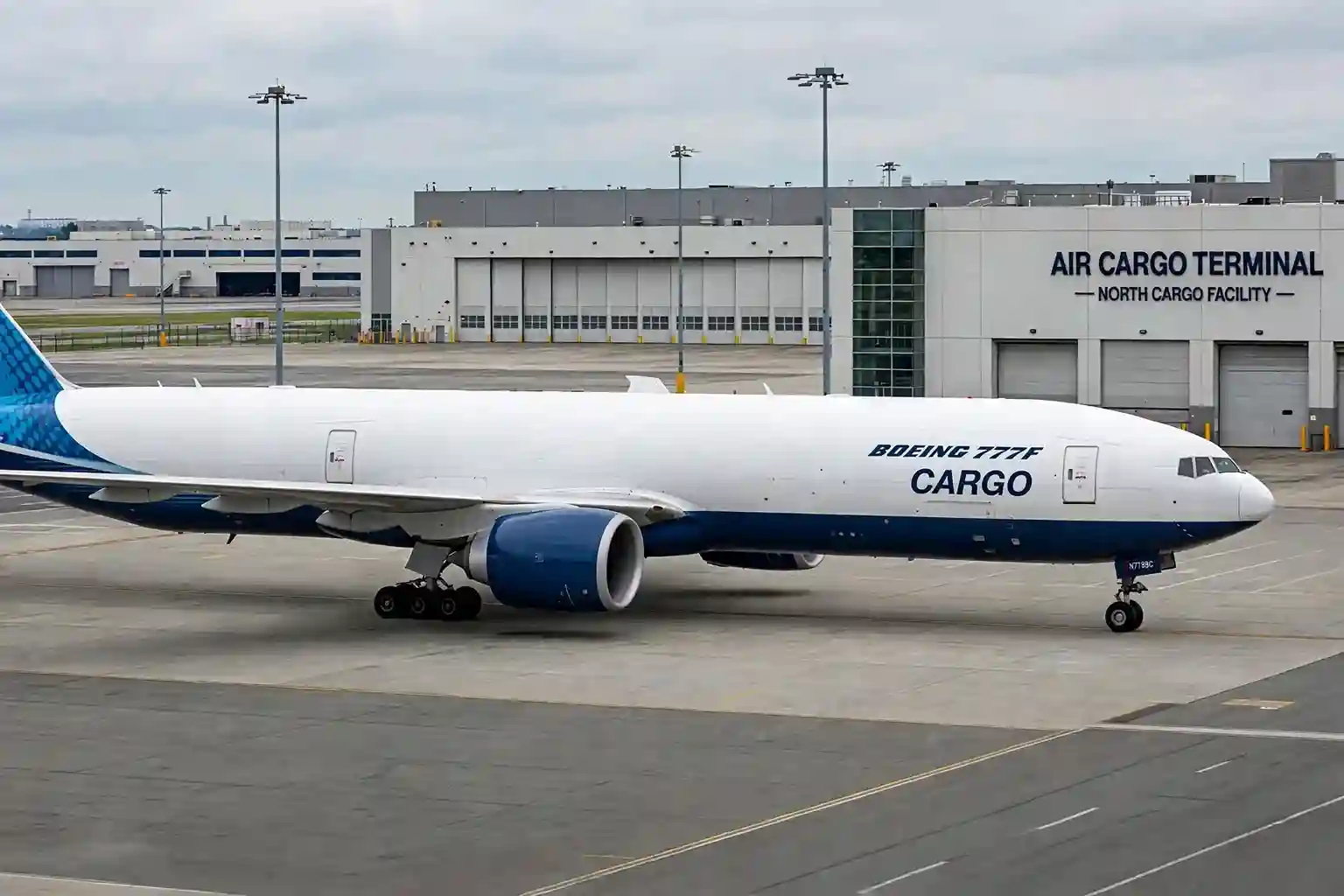
But growth brings constraints. Central Asia faces an estimated $33 billion in annual infrastructure requirements, and trade through the Middle Corridor could potentially triple by 2030. For larger aircraft like the Boeing 747F, 777F, and AN-124, airport infrastructure and ground handling are critical — runway capability, cargo terminal capacity, and specialist handling equipment all limit which airports can accept heavy freighters. Permits and regulatory clearances add another layer, while winter weather and de-icing can affect both timing and operating costs. The region's challenge isn't just how much air cargo capacity exists — it's whether the right capacity is available for the specific cargo, route, and deadline.
Air Rerouting Resilience Beyond Afghanistan
This pattern isn't unique to Afghanistan and Central Asia. When Middle East airspace closures over Iran, Iraq, Israel, and Jordan disrupted normal east-west air routing, airlines diverted through the South Caucasus corridor instead — by early 2026, as many as 1,000 flights a day were passing through the Azerbaijan air corridor linking Europe and East Asia. The broader lesson for shippers in this region holds regardless of which specific route is disrupted: air cargo adapts to geopolitical disruption on a timescale of weeks, not the years an overland infrastructure project requires.
This is a genuinely different corridor and trade logic from the Pakistan-China CPEC/Gwadar air corridor covered elsewhere on this site — that route serves a different geography (China-Pakistan freight via the Ezhou-Lahore route) entirely separate from Afghan and Central Asian connectivity to South Asia. See our CPEC air cargo corridor guide for that angle specifically.
Where Charter Fits In
Scheduled air corridors like Kabul-Delhi solve a real connectivity gap, but they don't cover every landlocked route, every volume level, or every moment a new disruption hits before scheduled capacity can adjust. Charter fills exactly that space — a dedicated flight for a specific landlocked route not yet served by scheduled service, a volume spike scheduled capacity can't absorb, or a time-critical shipment that can't wait for the next available scheduled slot.
The same mission-pricing logic covered in our charter cost guide applies here as much as anywhere else in the region. For perishable cargo moving on these routes — the dried fruits, fresh produce, and agricultural exports that dominate Afghanistan's outbound trade — the considerations are similar to those covered in our perishable cargo charter guide. And for project cargo serving Central Asia's mining, energy, and infrastructure build-out — equipment too large or heavy for scheduled networks — the dynamics mirror those in our urgent cargo charter coverage.