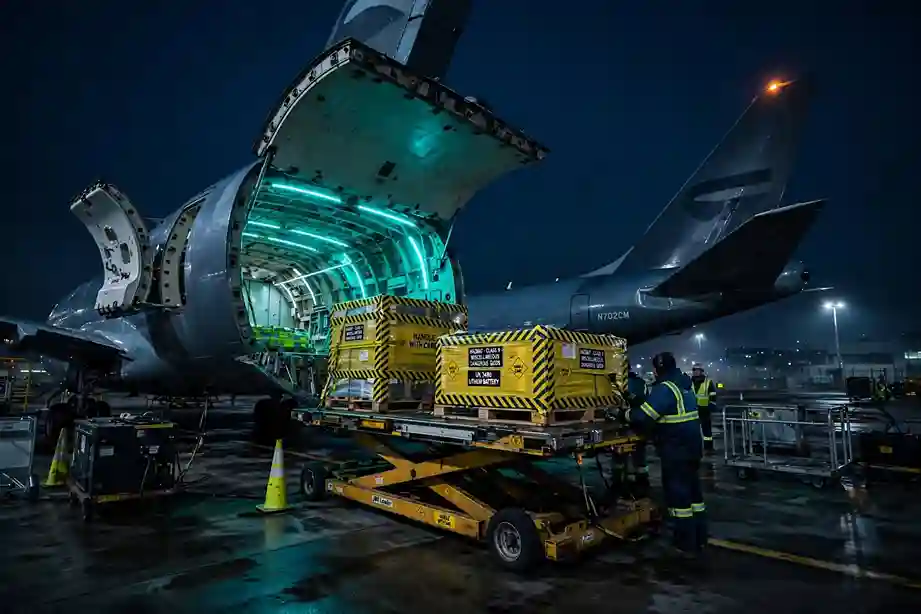
Quick answer: Shipping lithium batteries by air requires compliance with IATA Class 9 dangerous goods regulations. Standalone batteries (UN3480) are prohibited on passenger aircraft and must move Cargo Aircraft Only. From 1 January 2026, lithium-ion batteries packed with equipment (UN3481, PI 966) above 2.7 Wh must ship at a state of charge not exceeding 30%. Air freight costs $10–20 per kg all-in — roughly 3–5× sea freight — but delivers in 72 hours to 7 days instead of 25–40 days. Dedicated DGR cargo charter is often the only reliable way to move lithium batteries at scale or at speed, especially for damaged, defective, or recalled cells that scheduled carriers refuse.
With the global boom in electric vehicles (EVs), renewable energy storage, and consumer electronics, the demand for shipping lithium batteries by air has skyrocketed. However, transporting these energy-dense power sources is not as simple as loading them onto a standard freighter. Lithium batteries are classified as Class 9 Dangerous Goods (DGR) under the International Air Transport Association (IATA) regulations. For airlines, freight forwarders, and manufacturers, understanding the strict logistics, packaging, and compliance requirements is critical to preventing catastrophic incidents in the sky.
The Science of the Risk: Thermal Runaway
To understand why IATA enforces such strict regulations on lithium battery transport, one must understand the phenomenon of thermal runaway. Unlike standard cargo, lithium-ion and lithium-metal batteries store an immense amount of energy in a compact space. If a battery is damaged, improperly charged, or exposed to extreme heat, it can experience an internal short circuit.
This short circuit generates intense heat, which causes the battery's electrolyte to break down and release flammable gases. The heat cascades from one cell to the next, creating a self-sustaining fire that can reach temperatures exceeding 600°C (1,100°F). Worse, these fires are extremely difficult to extinguish. Standard aircraft fire suppression systems (like Halon 1301) are often ineffective against lithium battery fires, which can re-ignite hours after the initial blaze. At 35,000 feet, a thermal runaway event poses an existential threat to the aircraft and its crew.
That difference in consequence — a thermal runaway on a truck is bad, on an aircraft in flight it is catastrophic — is reflected in every requirement the DGR places on lithium battery shippers. Ground transport offers significant regulatory exceptions for small battery shipments, but those exceptions do not transfer to air. Shippers who take a ground-compliant package and route it through an air carrier sort centre will see it rejected every time.
What Changed in 2026: The 30% State of Charge Rule Extended
The 67th Edition of the IATA Dangerous Goods Regulations, effective 1 January 2026, extended the state-of-charge (SoC) limit for lithium-ion batteries transported by air. Under the previous rules, only UN3480 shipments — standalone batteries — were required to travel at 30% SoC or below.
Starting 1 January 2026, that requirement became mandatory for UN3481 as well. Specifically, lithium-ion batteries packed with equipment (PI 966) where cells or batteries have a watt-hour rating greater than 2.7 Wh must now be offered for transport at no more than 30% of their rated design capacity. Batteries contained in equipment (PI 967) carry this same limit as a strong recommendation, not yet a mandate.
SoC above 30% may only be shipped with the approval of the State of Origin and the State of the Operator, under written conditions established by those authorities. Reducing state of charge in large-format batteries takes time and supply chain coordination — some batteries have no SoC indicator at all, making proactive supplier requirements essential. The 2026 update also introduced stricter charge limits for lithium-ion batteries packed with equipment and a new shipper compliance checklist for battery shipments.
IATA Regulations and UN Packaging Specs
The IATA Dangerous Goods Regulations (DGR) is the global standard for shipping hazardous materials by air. Lithium batteries fall under Class 9 (Miscellaneous Dangerous Goods). The specific shipping requirements depend on whether the batteries are standalone (UN3480 for lithium-ion, UN3090 for lithium-metal), packed with equipment (UN3481), or contained in equipment (UN3091).
| UN Number | Configuration | Packing Instruction | Passenger Aircraft | 30% SoC Rule (2026) |
|---|---|---|---|---|
| UN3480 | Lithium-ion, standalone | PI 965 | Prohibited | Mandatory |
| UN3481 | Lithium-ion, packed with equipment | PI 966 | Restricted | Mandatory (above 2.7 Wh) |
| UN3481 | Lithium-ion, contained in equipment | PI 967 | Permitted with limits | Recommended only |
| UN3090 | Lithium-metal, standalone | PI 968 | Prohibited | N/A |
| UN3091 | Lithium-metal, with/in equipment | PI 969/970 | Restricted | N/A |
For standalone lithium batteries (UN3480), which are the most dangerous configuration, IATA mandates that they be shipped at a State of Charge (SoC) not exceeding 30% of their rated capacity. Furthermore, they must be packed in strict accordance with Packing Instruction (PI) 965. This requires:
- UN-Spec Packaging: Batteries must be packed in rigid outer packaging that meets United Nations performance standards (drop tests, stack tests, and pressure tests).
- Inner Protection: Each battery must be individually packed in inner packaging to prevent short circuits, movement, and accidental activation.
- Thermal Insulation: Packing materials must be non-combustible and provide thermal insulation to prevent the spread of heat if one cell fails.
- Labeling: Packages must display the Class 9 hazard label, the lithium battery mark (indicating UN number and phone number for information), and "Cargo Aircraft Only" labeling if applicable.
What Is a UN38.3 Test Summary and Do You Need One?
Many lithium batteries must pass safety testing under the UN Manual of Tests and Criteria, Subsection 38.3 before they can be transported. The UN 38.3 Test Summary provides key information showing that a particular battery type has passed the relevant transport safety tests. It is normally provided by the battery manufacturer or distributor.
The Test Summary should be accessible — you should be able to obtain the document that matches the battery model being shipped if it is requested. IATA does not generally require a paper copy to be placed inside every package. A QR code or URL can make the document easier to access online, but it is not required on every shipment. The document must match the battery — the battery model, manufacturer and other identifying information should be traceable to the correct Test Summary. If you source batteries from a supplier, request the UN 38.3 Test Summary before you begin planning the shipment, rather than trying to obtain it on the day of pickup.
The Limitations of Commercial Freight Networks
While commercial passenger and cargo airlines do transport lithium batteries, the process is fraught with delays and rejections. Commercial freight networks route cargo through massive hub-and-spoke systems. This means a shipment of batteries might sit on a hot tarmac in Dubai or Singapore for hours, increasing the risk of thermal degradation. Furthermore, many commercial airlines have implemented strict "operator variations" (variations to IATA rules) and refuse to carry standalone UN3480 batteries entirely due to the perceived risk.
When cargo is rejected at the airport, it causes severe supply chain bottlenecks. Manufacturers waiting for critical EV components or power grid infrastructure face costly downtime. The unpredictability of commercial DGR transport makes it unsuitable for high-volume or time-sensitive battery logistics.
Damaged, defective, or recalled (DDR) batteries are subject to Special Provision A154 and are forbidden for transport by air under normal conditions. Scheduled carriers routinely restrict or refuse them, especially damaged, defective, recalled or prototype cells. Dedicated charter with specialised DDR packaging is often the only compliant pathway.
What Does It Cost to Ship Lithium Batteries by Air?
Air freight for lithium batteries typically costs $10–20 per kg all-in, depending on route and carrier. The breakdown:
| Cost Component | Air Freight | Sea Freight |
|---|---|---|
| Base freight | $8–15/kg | $1–3/kg |
| Dangerous goods surcharge | $2–5/kg | $0.50–1/kg |
| Documentation fees | $50–150/shipment | $100–200/shipment |
| Insurance | 0.5–1% of cargo value | 0.3–0.7% of cargo value |
| Transit time | 72 hours – 7 days | 25–40 days |
Air freight costs roughly 3–5× more than sea freight, but delivers in days instead of weeks. The premium buys time and certainty — critical for EV production schedules, warranty recoveries, and time-sensitive energy storage deployments where a delay can halt a production line.
The Solution: Dedicated DGR Cargo Charter
For manufacturers and logistics providers moving high volumes of lithium batteries, a dedicated cargo aircraft charter is the safest, most compliant, and most efficient solution. By chartering a dedicated freighter (such as a Boeing 737-800BCF or Boeing 777F), shippers bypass the commercial hub-and-spoke system entirely. The cargo flies directly from the manufacturing facility to the destination airport.
A DGR cargo charter offers several critical advantages:
- Specialized Fire Suppression: Charter freighters can be equipped with advanced fire suppression systems, including fire containment covers (FCCs) and specialized pallets that can isolate a thermal runaway event for the duration of the flight.
- Direct Routing: Minimizing tarmac exposure time keeps the batteries at stable temperatures, reducing the risk of heat-induced chemical degradation.
- Guaranteed Acceptance: By negotiating directly with licensed AOC holders who are approved to carry Class 9 dangerous goods, shippers eliminate the risk of cargo rejection at the boarding gate.
- Speed: For urgent supply chain needs, a dedicated charter can have batteries airborne within 6–12 hours of booking, significantly faster than commercial freight booking windows.
- Single Point of Accountability: One owner across classification, packaging approval, handling, permits, and customs — eliminating the handoff failures that cause most DG shipment rejections.
Full charter becomes the right call when the cargo will not move on scheduled or passenger services, when timing is critical, or when a single accountable owner is needed across the entire compliance chain. Common triggers include damaged, defective or recalled batteries that scheduled carriers will not accept; prototype and pre-production cells outside standard UN 38.3 test documentation timelines; large-format EV and energy-storage packs exceeding passenger lower-deck limits; high state-of-charge or high-volume shipments needing dedicated lift; time-critical production, warranty or field-failure recoveries; and security-sensitive or high-value cells requiring chain-of-custody.
The Skylinks Asia Advantage in DGR Logistics
Navigating IATA dangerous goods regulations requires expert coordination. A single mislabeled box or incorrect State of Charge reading can ground an entire shipment. As an independent aircraft charter broker, Skylinks Asia acts as your compliance and logistics advocate. We do not own aircraft; instead, we leverage our extensive network of licensed AOC holders across Asia, the Middle East, and Africa to source the most reliable freighter aircraft for your dangerous goods cargo.
We handle the negotiation, flight planning, overflight permit acquisition, and ground handling coordination, ensuring that every step of the journey adheres strictly to IATA DGR regulations. From the moment your lithium batteries leave the factory to the moment they touch down at their destination, our team ensures a zero-blur, fully transparent, and highly compliant logistics chain. For shipments requiring additional capacity beyond a single charter, our ACMI wet lease service provides flexible aircraft, crew, and maintenance solutions.