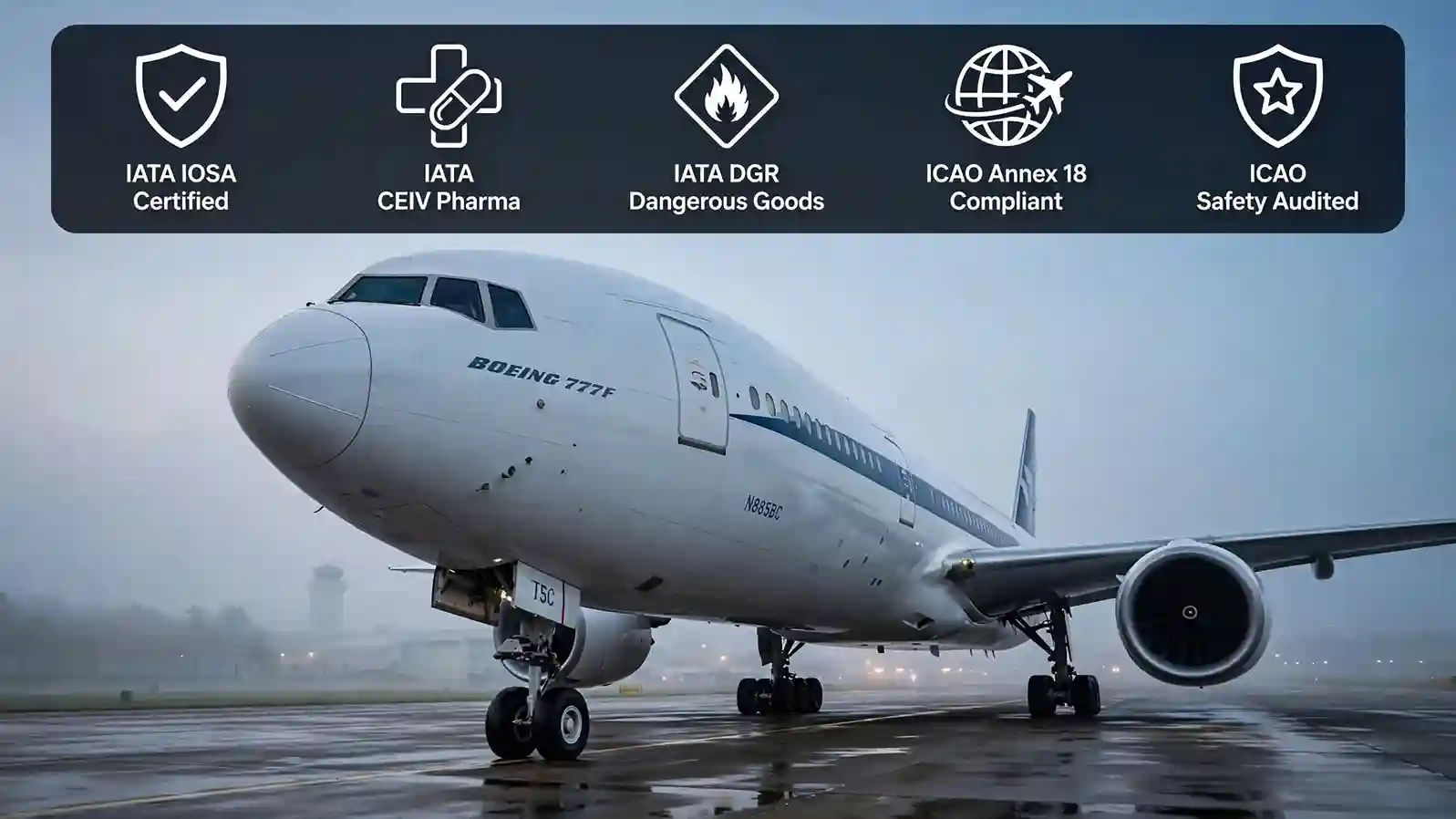
TL;DR: ARGUS, Wyvern, and IS-BAO are voluntary third-party safety rating systems for business aviation operators, sitting on top of the legally required Air Operator's Certificate (AOC) rather than replacing it. ARGUS and Wyvern rate an operator's historical safety record and audit outcomes in tiers (ARGUS: Gold through Platinum; Wyvern: Wingman and Wingman PRO). IS-BAO, managed by the International Business Aviation Council (IBAC) and built on ICAO principles, certifies the maturity of an operator's Safety Management System across three stages instead. For scheduled and charter airlines — including cargo operators — the equivalent program is IOSA (IATA Operational Safety Audit), the benchmark most relevant to the wider charter network Skylinks works with across Asia, the Middle East, and Africa.
Do These Safety Ratings Replace the Air Operator's Certificate?
No. None of the ratings covered here is a substitute for a valid Air Operator's Certificate. An operator doesn't gain legal flight authority by holding an ARGUS rating, completing a Wyvern audit, or registering with IS-BAO — the AOC, issued by a national civil aviation authority, is what makes the flight legal in the first place. As covered in our broker vetting guide, checking the AOC is the first step, not the last.
These programs are voluntary, independent layers on top of that legal minimum, designed to show how far an operator goes beyond baseline compliance. That distinction matters: a strong rating is meaningful precisely because it's voluntary, but it never stands in for the licence itself.
How Do ARGUS, Wyvern, and IS-BAO Differ?
The three best-known business aviation programs measure different things, using different methods:
| Program | Administering Body | What It Measures | Structure |
|---|---|---|---|
| ARGUS (ARG/US) | ARGUS International | Historical safety record + on-site SMS audit | Tiers: Registered/Certified → Gold → Gold Plus → Platinum |
| Wyvern | Wyvern | SMS, crew, and maintenance standards, plus per-trip validation | Wingman and Wingman PRO, with PASS report issued per trip |
| IS-BAO | IBAC | Maturity of an operator's Safety Management System, built on ICAO principles | Three progressive stages (Stage 1, 2, 3) rather than a single tiered rating |
A practical distinction: ARGUS and Wyvern evaluate an operator at a point in time — a historical record plus an audit snapshot. IS-BAO instead measures how deeply a safety culture is embedded in day-to-day operations, re-verified on a multi-year audit cycle. The two approaches are complementary rather than competing, which is why operators serious about safety credentials often carry more than one.
What Is IOSA — and Why Does It Matter for Cargo Charters?
ARGUS, Wyvern, and IS-BAO are built primarily around business jet operators. For scheduled and charter airlines — including the cargo operators Skylinks works with for charter sourcing and freighter missions — the equivalent benchmark is IOSA, the IATA Operational Safety Audit.
IOSA evaluates an airline's operational management and control systems across eight areas, including flight operations, dispatch, aircraft engineering and maintenance, ground handling, cargo operations, and operational security. Registration requires passing an audit from an IATA-accredited audit organization, and airlines must renew every two years to remain on the IOSA registry. All IATA member airlines are required to maintain IOSA registration, though IATA membership itself isn't required to undergo the audit — a number of non-member airlines carry IOSA registration as well.
For a charter brokerage sourcing cargo aircraft across Asia, the Middle East, and Africa, IOSA registration is a meaningfully more relevant filter than ARGUS or Wyvern, simply because it's the program the airlines and cargo carriers in this market actually participate in. Widebody freighters like the Boeing 777F typically move through IOSA-registered operators, not business-jet-rated ones.
Which Rating Matters Most in Asia, the Middle East, and Africa?
For operators across these three regions specifically, IS-BAO tends to carry more weight than ARGUS or Wyvern, both of which originated in — and remain most concentrated in — the US business aviation market. IS-BAO's ICAO foundation gives it broader international recognition and relevance to conversations with civil aviation authorities outside North America.
For scheduled and charter airline operations — the vast majority of cargo charter in this market — IOSA registration is the more widely held and relevant credential, as covered in our analysis of DGR cargo operations in Pakistan. Understanding which program to ask about, given the mission at hand, is more useful than treating any single rating as the universal benchmark.
What Do These Safety Ratings Not Tell You?
A caution worth taking seriously: these programs measure documentation and audit-moment compliance, not how an operator performs day-to-day or under commercial pressure between audits. Regulatory safety bodies have specifically warned that voluntary ratings can create a false sense of complete safety assurance for charter buyers who treat a rating as the whole picture rather than one input among several — alongside the operator's own track record, the specific aircraft and crew assigned to a mission, and a broker's independent vetting, as covered in our guide to how air charter brokerage works.
The practical takeaway: a strong rating is a genuine positive signal, not a guarantee. Use it the way it's meant to be used — as one layer of a broader verification process, not the entire process.
Frequently Asked Questions
ARGUS evaluates an operator's historical safety record plus an on-site Safety Management System audit, assigning tiered ratings from Gold through Platinum. Wyvern evaluates SMS, crew, and maintenance standards through its Wingman program, plus a per-trip PASS report. IS-BAO, built on ICAO principles, certifies how deeply a Safety Management System is embedded in daily operations across three progressive stages rather than a single tiered rating.
No. ARGUS, Wyvern, and IS-BAO are all voluntary, independent programs. None of them grants legal flight authority — that comes only from the operator's Air Operator's Certificate, issued by a national civil aviation authority.
Platinum is ARGUS's top standard tier, requiring a full on-site ARGUS audit along with a developed Safety Management System and a workable Emergency Response Plan, building on the requirements for the Gold and Gold Plus tiers below it.
ARGUS and Wyvern are designed primarily for business jet charter operators. IOSA (IATA Operational Safety Audit) is the equivalent program for scheduled and charter airlines, including cargo carriers, auditing eight operational areas and requiring renewal every two years to remain on the registry.
No — the three are complementary rather than interchangeable. ARGUS and Wyvern provide point-in-time ratings based on historical record and audit outcomes; IS-BAO measures the ongoing maturity of an operator's safety culture. Operators serious about demonstrating safety commitment often hold more than one.
ARGUS, Wyvern, and IS-BAO are oriented toward business jet operators. Cargo charter, particularly on scheduled or charter airlines rather than business jets, is more commonly assessed through IOSA, which explicitly includes cargo operations as one of its audited areas.
Yes. These ratings measure documentation and audit-moment compliance, not guaranteed future performance. A strong rating is a genuine positive signal about an operator's systems and track record, but it's one input into a broader vetting process, not a substitute for it.
IS-BAO tends to carry more international recognition in this region than ARGUS or Wyvern, both of which are most concentrated in the US business aviation market. For airline and cargo-carrier charter specifically, IOSA registration is generally the more relevant and widely held credential.