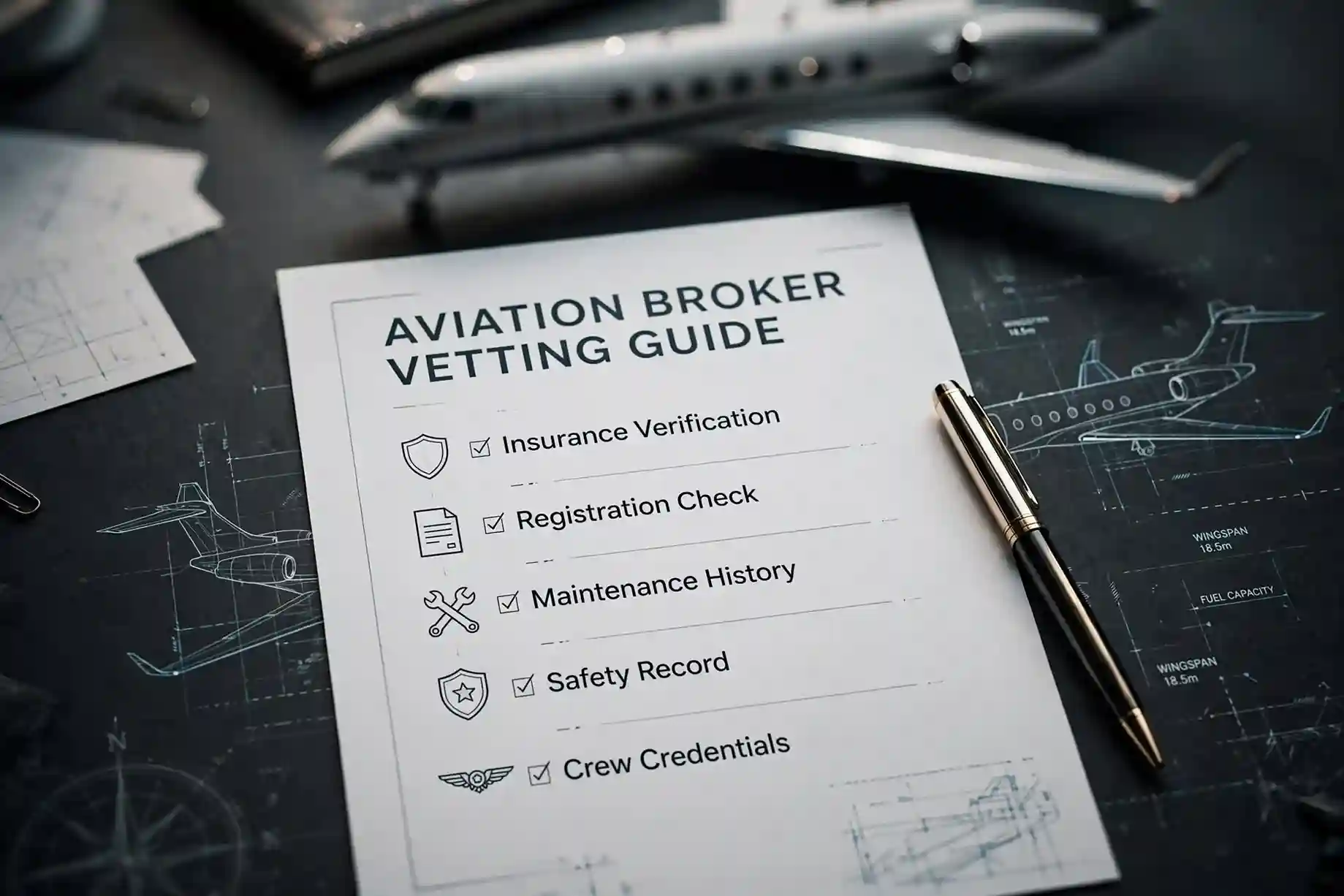
TL;DR: Charter brokerage — for both private jet and cargo charter — is lightly regulated in most markets: anyone can call themselves a broker with no licensing requirement. The protection comes from verifying the operator directly, not from trusting the broker's word alone. Before paying for any charter, confirm the operator's name and Air Operator's Certificate (AOC) with the civil aviation authority that issued it, verify insurance coverage directly with the insurer, and treat too-good-to-be-true pricing, pressure for wire transfers to personal accounts, and refusal to name the operator upfront as serious warning signs.
Why does vetting matter when brokerage isn't a safety credential?
A charter broker arranges the flight. The broker doesn't fly it, and in most jurisdictions, being a broker doesn't require any license, safety certification, or regulatory oversight at all. The actual safety and legal compliance sits with the operator — the company that holds the Air Operator's Certificate (AOC) and actually owns or leases the aircraft and employs the crew.
That distinction matters because a broker's reassurance — "don't worry, it's a reputable operator" — isn't itself verification. A legitimate broker should be able and willing to name the operator and provide documentation proving the operator's standing, and should expect you to check that documentation independently rather than take it on faith. If a broker resists that, the resistance itself is the red flag, not an inconvenience to tolerate. For a closer look at how a properly run brokerage relationship is supposed to work, see our guide on how air charter brokerage works, and for the operational background of our own desk, see about Skylinks Asia.
What are the red flags to watch for in a charter quote?
A short list of warning signs covers most real-world charter fraud and illegal-charter cases, whether the shipment is a passenger flight or cargo:
-
Pricing well below the market rate. Charter is inherently expensive because it dedicates an entire aircraft, crew, and ground-handling chain to one mission. A quote dramatically undercutting every other broker's number for the same route and aircraft class should raise suspicion, not excitement. For benchmark pricing context, see how much it costs to charter an aircraft. -
The operator or specific aircraft isn't disclosed upfront. A legitimate broker names the operator and aircraft registration before asking for payment. Vague answers ("a reputable partner," "a well-known operator") are a documented pattern in fraud cases. -
Payment requested to a personal account, or in cryptocurrency, before a formal agreement exists. Legitimate charter payments go to a business account tied to the operator or a bonded broker trust account, backed by a written charter agreement — not a personal account or an unconventional payment method. -
No formal written charter agreement. A contract specifying the aircraft, operator, route, dates, and cancellation terms is standard practice. Its absence, or reluctance to provide one, is a serious warning sign. -
Refusal or inability to provide the operator's AOC number or insurance certificate. Both should be freely available on request. A genuine operator has nothing to hide here, because this documentation is routinely requested by freight forwarders, cargo shippers, and passengers alike. -
Pressure to decide immediately, paired with urgency language discouraging you from independently verifying the operator or taking time to review the contract. -
Vague or unverifiable safety credentials — claims of "full compliance" or "top safety rating" without a specific, checkable certification (an IOSA registration number, an ARGUS or Wyvern rating) attached.
How do you actually verify a charter operator?
Verification isn't complicated, and a legitimate broker will expect — not resent — these steps:
- Request a copy of the operator's AOC and confirm the operator name on it matches who you're actually contracting with. Then verify the AOC directly with the civil aviation authority that issued it. For a Pakistan-registered operator, that's the Pakistan Civil Aviation Authority (PCAA) — the same body that oversees DG training approval, covered in more detail in our guide to shipping dangerous goods to and from Pakistan. For other countries, their equivalent national authority.
- Confirm the operator is entitled to perform the specific flight, not just that it holds an AOC generally. Operators need traffic rights and permits for the specific route and countries involved, and a valid AOC alone doesn't guarantee those are in place for your exact mission.
- Verify insurance coverage directly with the insurer, not just by taking the operator's word that coverage exists. A Certificate of Insurance (COI) obtained directly from the insurance provider confirms current, active coverage for the specific aircraft and operation.
- Check for independent safety-audit registration — IOSA (IATA Operational Safety Audit) for airlines, or ARGUS and Wyvern ratings in the business aviation world — as a reasonable proxy for operational standards, on top of the AOC itself.
- Research the operator and broker independently, including searching the company and principal names alongside terms like "fraud" or "complaint." Documented fraud cases are frequently discoverable this way before you ever pay a deposit.
- Confirm broker-association membership where relevant — IATA accreditation for cargo-focused brokers, or membership in an established industry body like The Air Charter Association (BACA) for business aviation — as an additional, though not sole, trust signal.
The same aircraft-type due diligence applies regardless of mission type — if the operator is putting forward a Boeing 737-800 for a group passenger charter, for example, the registration on the aircraft should trace back to the named operator on the AOC. If it doesn't, that's a stop signal.
What will a legitimate charter broker always disclose?
Before asking for payment, a broker you can trust will tell you: the operator's name, the aircraft's registration number, the applicable insurance coverage, and the terms of a formal charter agreement. If any of these is missing, vague, or described as "proprietary," that's reason enough to pause and verify independently before proceeding — or to walk away entirely. This same transparency standard applies whether you're arranging a one-off private jet charter or a multi-sector cargo programme.
Broker Vetting & Verification
In most markets, no — or only lightly so. Anyone can describe themselves as a charter broker with no licensing requirement specific to the brokering activity itself. The regulatory weight sits with the operator, who must hold a valid Air Operator's Certificate (AOC), not with the broker arranging the booking.
An Air Operator's Certificate is issued by a national civil aviation authority and certifies that an operator has met the safety, maintenance, and operational standards required to legally conduct commercial flights. Chartering through an operator without a valid AOC is illegal in most jurisdictions, and it's likely to void any insurance coverage on the flight as well.
A price significantly below what every other broker is quoting for the same route and aircraft class. Charter economics don't allow for dramatic undercutting on a genuine, fully compliant operation — when a deal looks too good to be true, it usually reflects either an unlicensed operator or an outright scam.
Because it removes your ability to verify anything independently. A legitimate broker names the operator and aircraft before taking payment specifically so you can check the AOC, insurance, and safety record yourself — refusal to disclose this information removes that check entirely, which is precisely the pattern documented in known charter fraud cases.
Not inherently — a broker with an established network and a track record of vetting operators can reduce risk by doing that verification work for you. The risk comes from working with an unverified broker, not from brokerage as a model; see our brokerage guide for how a properly vetted broker relationship is supposed to work.
Don't proceed with payment, and verify the operator's AOC directly with the issuing civil aviation authority before any money changes hands. If you've already lost money to a fraudulent broker or operator, documenting and reporting the case — including to industry bodies that track known bad actors — is worth doing even after the fact, both for recovery attempts and to protect others.
Occasionally, through genuine empty-leg availability — an aircraft already flying your route anyway with no return booking — which can be priced well below a dedicated charter. The distinction is that a legitimate empty-leg discount comes with full operator disclosure and documentation, the same as any other charter; a discount that comes with secrecy about the operator is the red flag, not the discount itself.
The operator owns or leases the aircraft, employs the crew, and holds the AOC that makes the flight legal — they're the regulated party. The broker arranges the booking, sources the aircraft, and manages the transaction on the client's behalf, but doesn't itself fly the aircraft or hold aviation safety certification. Verification needs to reach the operator, not stop at the broker's own assurances.