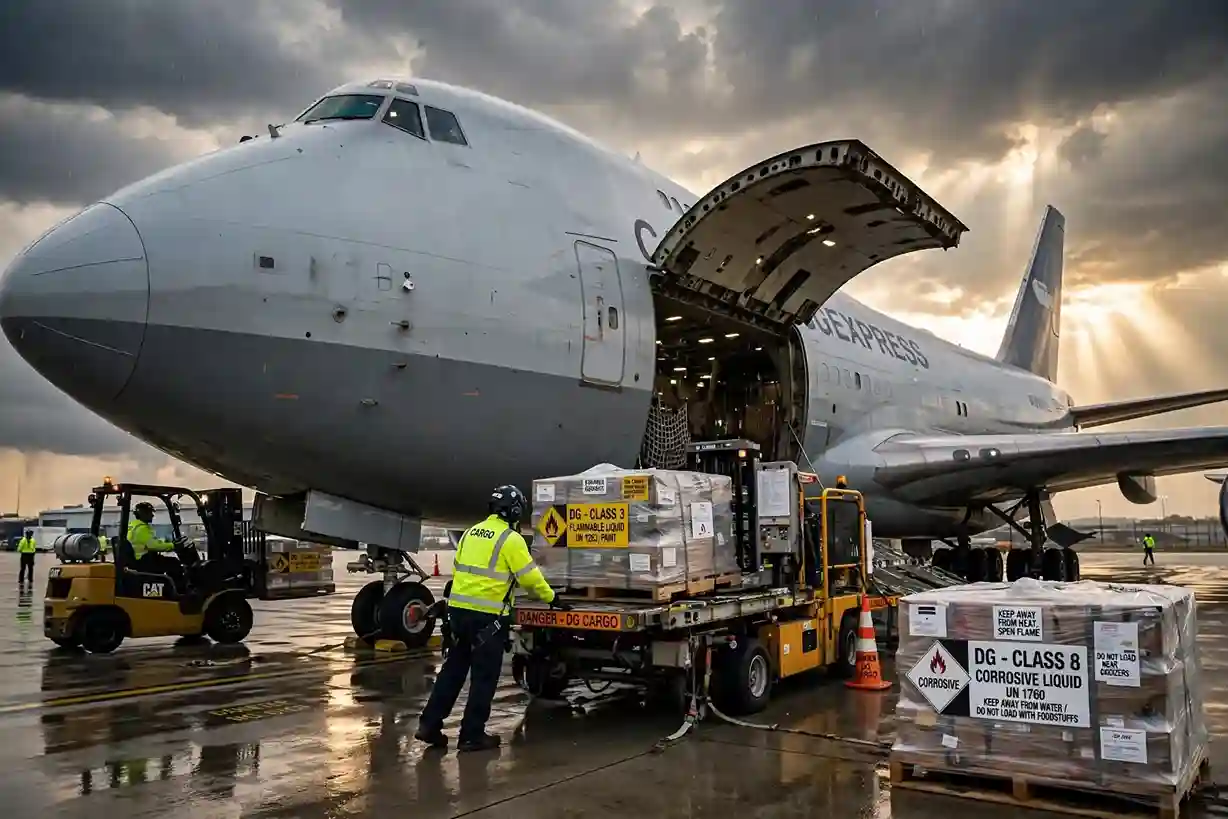
Dangerous Goods Air Cargo Pakistan
Aviation Insights & Cargo Guides

Dangerous Goods (DGR) Cargo To and From Pakistan: A Shipper’s Guide

By the Skylinks Asia Aviation Team · Reviewed by our Operations Team · October 2026

Quick answer: Pakistan follows the IATA Dangerous Goods Regulations (DGR), built on the ICAO Technical Instructions, with the Pakistan Civil Aviation Authority (PCAA) as the national oversight body. In practice, DG cargo into and out of Pakistan moves through a small number of IOSA-registered carriers and DG-trained ground handlers, concentrated at Jinnah International (Karachi), Allama Iqbal International (Lahore), and Islamabad International. The categories that most often trigger DG classification on Pakistani air cargo are lithium batteries (e-commerce and sporting-goods electronics), leather-industry tanning chemicals, dry ice supporting pharma cold-chain exports, and general industrial chemicals. When scheduled belly space for DG is full, delayed, or the wrong class for a given route, charter becomes the practical alternative.

Why does Pakistan-specific DGR guidance matter?

Most DGR guidance online is generic — global classification rules, packing instructions, hazard classes. That is necessary but not sufficient for a shipper actually moving cargo through Pakistani airports. Two things are specific to Pakistan and worth knowing before you book: which gateways can actually accept your DG shipment, and which categories of Pakistani cargo run into DG classification more often than shippers expect. This guide covers both, then looks at when charter makes more sense than waiting on scheduled capacity.

For the underlying classification, packaging, and documentation rules themselves, see our dangerous goods charter guide — this post assumes that baseline and focuses on the Pakistan-specific layer on top of it.

How does Pakistan regulate dangerous goods air cargo?

Pakistan is a signatory to the Chicago Convention, so its dangerous goods framework sits on the same foundation as most of the world’s: the ICAO Technical Instructions for the Safe Transport of Dangerous Goods by Air, with airlines and freight forwarders operating to the more detailed, annually revised IATA DGR manual, since IATA’s DGR is the version airlines and ground handlers actually work from day to day.

The Pakistan Civil Aviation Authority (PCAA) is the national body responsible for enforcing this framework — issuing and overseeing the dangerous goods training approvals that shippers, freight forwarders, and ground handling staff are required to hold before they can prepare, accept, or handle DG consignments. Pakistan-based DG training providers operate under PCAA supervision, delivering the IATA Category-based courses (from Category 6 shipper courses through the higher categories required for ground handling and acceptance staff) that keep personnel current with each year’s DGR edition.

A few practical implications for shippers:

  • Carrier selection matters more for DG than for general cargo. Not every airline serving Pakistan accepts every DG class, and Pakistani carriers publish their own operator variations narrowing what IATA’s baseline DGR would otherwise allow — the same way most international carriers do. Always confirm acceptance for your specific UN number and packing group before booking, not just the hazard class.
  • IOSA registration is a useful filter. Carriers that hold IATA Operational Safety Audit registration have had their DG handling procedures independently audited against IOSA standards, which is a reasonable proxy for reliability when comparing options on a Pakistan route.
  • DGR editions change annually, and recent editions have tightened requirements around lithium battery documentation specifically — including a firmer requirement that the Shipper’s Declaration carry a 24-hour emergency contact number. A shipment prepared to last year’s edition can be rejected at acceptance on a technicality that has nothing to do with the goods themselves.

What Pakistani cargo commonly needs DG classification?

Most shippers don’t set out to ship “dangerous goods” — they ship a product, and the product happens to contain or require something that IATA classifies as DG. In Pakistan’s case, a handful of major export and import categories account for most of this.

  • Lithium batteries in e-commerce and sporting-goods electronics. Pakistan’s e-commerce export volume and its electronics-adjacent sporting goods sector (fitness trackers, powered training equipment, battery-backed devices bundled with sports gear) both move lithium cells as a matter of course. Batteries packed with or contained in equipment typically ship under UN3481 (lithium ion) or UN3091 (lithium metal) via Section II of the relevant packing instruction, which carries lighter documentation requirements than a standalone battery shipment — but it is still dangerous goods, still needs a hazard label and watt-hour rating on the package, and is still routinely misdeclared industry-wide when shippers assume “packed with equipment” means “not DG.”
  • Leather-industry chemicals. Pakistan’s tanning industry is one of the country’s largest export sectors and runs on a steady supply of imported tanning inputs — chrome salts, synthetic dyestuffs, wetting and degreasing agents, biocides — several of which fall under DGR as corrosive (Class 8) or oxidizing substances depending on formulation. These typically move as sea freight given the volumes involved, but urgent replenishment shipments and smaller specialty-chemical consignments do move by air, and get classified accordingly.
  • Dry ice supporting pharma cold-chain exports. As covered in our cold-chain pharma guide, dry ice is Class 9 dangerous goods under IATA DGR because it releases carbon dioxide gas in an enclosed space. Any Pakistani pharmaceutical or biologics exporter using passive dry-ice packaging for temperature-sensitive shipments is, by definition, tendering DG cargo alongside their product — a detail that’s easy to overlook when the focus is on temperature compliance rather than the packaging medium itself.
  • General industrial and laboratory chemicals, moving in both directions to support Pakistan’s manufacturing and textile sectors, round out the remaining volume — flammable liquids, corrosives, and the occasional oxidizer, mostly moving under standard IATA packing instructions rather than anything Pakistan-specific.

Where does DG cargo actually move through Pakistan?

  • Jinnah International Airport (KHI), Karachi is Pakistan’s largest cargo gateway and the country’s main hub for Pakistan International Airlines and several private carriers. Karachi’s cargo-handling infrastructure includes a dedicated GDP-certified pharma handling facility for temperature-sensitive cargo, run by a ground handler serving multiple airlines across several Pakistani airports — relevant directly to the dry-ice-and-pharma overlap above.
  • Islamabad International and Allama Iqbal International (Lahore) both operate dedicated cargo terminals with designated dangerous-goods storage areas and DG-trained handling staff, alongside general import/export cargo sheds.

The practical takeaway for shippers: not every airport with a runway and a cargo shed in Pakistan is set up to accept and store DG cargo. Confirm DG handling capability at both the origin and destination airport before committing to a routing, particularly for anything outside the three main gateways above.

When should you charter DG cargo instead of waiting on scheduled space?

Scheduled belly cargo remains the default for most DG shipments out of Pakistan — it’s more cost-effective and the infrastructure above exists specifically to support it. Charter becomes the more sensible option in a few recurring situations:

  • The specific UN number or packing group isn’t accepted on the scheduled carriers serving your route, but is acceptable on a cargo aircraft under a charter operator’s variation.
  • Time-critical replenishment — a tannery or manufacturer waiting on a chemical input, or a pharma exporter with a cold-chain shipment that can’t wait for the next scheduled DG-capable flight.
  • Volume exceeds what a single scheduled flight can carry, common with larger specialty-chemical or dry-ice-heavy pharma consignments.
  • Passenger-aircraft restrictions apply to a shipment that would otherwise need to move on an all-cargo aircraft only, narrowing the scheduled options further — see our guide on which dangerous goods require cargo-aircraft-only charter for the classes this applies to.

If you’re weighing charter for a DG shipment to or from Pakistan, get in touch with the Skylinks Asia charter desk with your UN number, packing group, quantity, and routing, and we’ll confirm operator acceptance and available capacity.

Frequently Asked Questions

Pakistan applies the ICAO Technical Instructions and IATA DGR framework used internationally, with the Pakistan Civil Aviation Authority (PCAA) responsible for national oversight and training approval. There isn’t a separate, materially different Pakistani DG rulebook — practical differences come from individual carrier operator variations, not a distinct national standard.
Jinnah International (Karachi), Allama Iqbal International (Lahore), and Islamabad International all have dedicated cargo terminals with DG storage and DG-trained staff. Smaller domestic airports generally aren’t set up for DG cargo acceptance.
Yes, when properly classified, packed, and documented under IATA DGR — most commonly as UN3481 or UN3091 batteries packed with or contained in equipment. They remain dangerous goods even under the lighter Section II documentation requirements.
Some carriers accept a limited set of DG categories permitted on passenger aircraft under IATA DGR, such as certain lithium battery configurations and dry ice within quantity limits. Fully regulated dangerous goods require an all-cargo aircraft. Acceptance varies by carrier and UN number.
Misdeclared or undeclared DG cargo is grounds for rejection at acceptance, and discovery after loading is treated as a safety incident with its own reporting requirements, consistent with international DGR practice.
Pakistan’s pharmaceutical and biologics exporters increasingly use dry ice as a passive cold-chain packaging medium. Because dry ice is Class 9 dangerous goods, any shipment using it needs DG documentation alongside the product’s own export paperwork.
Most tanning-chemical volume moves by sea given typical quantities, but urgent or smaller specialty consignments — chrome salts, dyestuffs, and similar tanning inputs — do move by air and require DG classification as corrosive or oxidizing substances depending on formulation.
Charter is worth considering when a specific DG classification isn’t accepted by scheduled carriers on the route, when the shipment is time-critical, when volume exceeds a single scheduled flight’s capacity, or when the cargo can only move on an all-cargo aircraft and scheduled capacity is limited.
Continue Reading

Related Aviation Insights

Need to Charter DG Cargo?

If you’re weighing charter for a DG shipment to or from Pakistan, get in touch with the Skylinks Asia charter desk with your UN number, packing group, quantity, and routing, and we’ll confirm operator acceptance and available capacity.