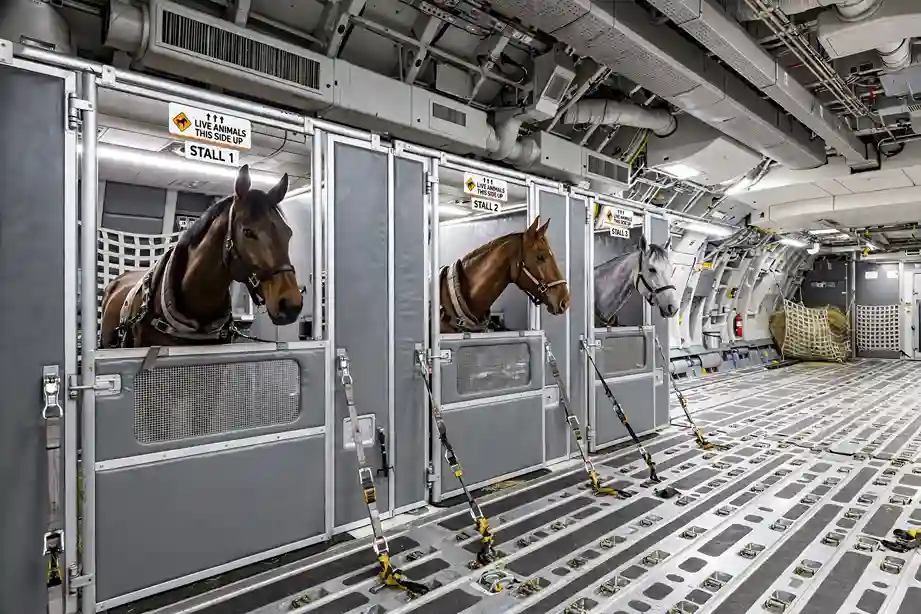
TL;DR: Live animal air cargo — racehorses, livestock, zoo and conservation animals, and pets — is governed by IATA's Live Animals Regulations (LAR), a dedicated manual covering container specifications, documentation, and species-specific handling, separate from both DGR and PCR. The clearest example of this category's scale and complexity is the Gulf's thoroughbred racing circuit: Dubai's Meydan Racecourse alone brought 101 horses from 17 countries to the 2026 Dubai World Cup, flown in climate-controlled jet stalls with flying grooms in attendance, under veterinary and quarantine protocols managed for weeks before the race itself.
What Does IATA's Live Animals Regulations (LAR) Actually Cover?
The IATA Live Animals Regulations (LAR), maintained by the IATA Live Animals & Perishables Board, is the global standard for air-transporting live animals of every kind — pets, racehorses, zoo and conservation animals, livestock, and laboratory or agricultural animals. It governs four core areas:
- Container specifications by species — from standard pet carriers through purpose-built jet stalls for horses.
- Government and carrier-specific regulations by country — including import permits and disease-control requirements.
- Documentation requirements — shipper's certification, dedicated air waybill, and captain notification of species, location, and quantity of live cargo aboard.
- Species-specific handling — temperature, ventilation, feeding, and rest intervals during transit.
One rule worth knowing: live animals must not be entered on the same air waybill as other commodities, regardless of how the shipment is otherwise consolidated. For temperature-sensitive live cargo the handling requirement runs parallel to pharma and cold chain charter protocols, though the applicable rulebook is LAR, not IATA's Temperature Control Regulations.
IATA has also launched LAR Verify, a digital portal giving airlines, shippers, and freight forwarders real-time access to operator- and destination-specific requirements, including live updates on regional embargoes and disease-outbreak-related restrictions — a meaningful improvement over manually cross-checking country-by-country rules for every shipment.
How Do Racehorses Actually Fly to the Gulf's Racing Circuit?
Nowhere does live animal air charter operate at greater scale or stakes than the Gulf's thoroughbred racing calendar. The Dubai World Cup, held at Meydan Racecourse, marked its 30th edition in 2026 with a $30.5 million prize purse across nine races and 101 horses from 17 countries competing. The Saudi Cup, one of the world's richest horse races, has relied on dedicated charter flights to bring horses in from as far as Los Angeles and Miami.
The logistics behind this are genuinely specialized. Horses travel in purpose-built jet stalls — up to 25 per aircraft, with up to three horses per stall — fitted with rubberized flooring, foam padding, and hay nets, in cargo holds held at a steady 12-15°C. Widebody freighters such as the Boeing 777 are commonly configured for this kind of mission. Professional flying grooms travel with the horses throughout. On arrival, horses move directly into mandated quarantine stabling — Dubai Racing Club operates dedicated quarantine facilities near the airport specifically for this purpose — for a period set by their country of origin, well before they are cleared to train or race.
2026 demonstrated exactly why charter flexibility matters in this category: when regional airspace closures disrupted the usual routing, operators arranged a four-hour climate-controlled road transfer from Doha to Riyadh so horses could fly onward from Saudi Arabia instead, where airspace remained open — preserving the horses' condition and getting them to Dubai in time for the 30th Dubai World Cup to proceed as scheduled. It's a concrete illustration of the same principle covered in our repatriation and government charter guide: charter's ability to reroute around regional disruption is exactly what scheduled service often cannot offer.
What Other Live Animals Move by Air Charter?
Beyond headline racing events, live animal charter also moves:
- Breeding livestock and genetics — pedigree cattle, dairy breeding stock, and other agricultural animals requiring quarantine-compliant transport.
- Zoo and conservation animals — relocating between institutions, often under species-specific veterinary supervision and CITES oversight.
- Working and competition animals — police, military, and service animals, plus competition animals outside the racing circuit.
Each is governed by the same LAR container and documentation framework, adjusted for species-specific needs around temperature, ventilation, feeding, and rest intervals during transit. Mission pricing follows the same logic as any specialized charter — see our charter cost breakdown for how these add-on costs stack on top of base aircraft hire.
What Are the CITES Requirements for Protected Species?
Any live animal shipment involving a CITES-listed (Convention on International Trade in Endangered Species) species requires the relevant export and import CITES permits in addition to standard LAR documentation. These requirements exist specifically to prevent illegal wildlife trade, and they apply regardless of the animal's destination or stated purpose. For a broader view of how compliance frameworks shape air charter planning, see our cargo aircraft charter guide for Asia, Africa and the Middle East.
Skylinks only arranges live animal charter where full LAR and, where applicable, CITES compliance is confirmed in advance.
Frequently Asked Questions
LAR is IATA's global standard for transporting live animals by air, covering container specifications, documentation, and species-specific handling. It applies to anyone shipping live animals by air — individuals relocating pets, breeders and livestock exporters, zoos and conservation programs, and competition or racing operations — not only IATA member airlines.
They can share a charter flight alongside compatible general cargo, but live animals must not be entered on the same air waybill as other commodities — LAR requires their own dedicated waybill regardless of how the broader shipment is consolidated.
In purpose-built jet stalls — up to 25 per aircraft, with up to three horses per stall — fitted with padded, rubberized flooring and hay nets, in a cargo hold held at a steady temperature around 12-15°C. Professional flying grooms travel with the horses, and the animals move into mandated quarantine facilities immediately on arrival.
Regional airspace closures or restrictions can force a change of departure or arrival airport on short notice. In 2026, this meant a climate-controlled road transfer from Doha to Riyadh so horses could fly onward from Saudi airspace that remained open, preserving their condition and schedule for the Dubai World Cup — exactly the kind of routing flexibility dedicated charter is built to provide.
A shipper's certification, a dedicated air waybill, and captain notification of the species, location, and quantity of live cargo aboard, plus any country-specific import or export permits and veterinary health certificates relevant to the species and route.
Yes. Any shipment involving a CITES-listed species requires valid export and import CITES permits in addition to standard LAR documentation, specifically to prevent illegal wildlife trade. These requirements apply regardless of the stated purpose or destination of the shipment.
It's a digital portal IATA launched to give airlines, shippers, and freight forwarders real-time access to operator- and destination-specific live animal requirements, including live updates on regional embargoes and disease-outbreak restrictions, reducing reliance on manually cross-checking country-by-country rules.
Typically yes, given the specialized stalls, climate control, veterinary oversight, and attending handlers or grooms required — these are mission-specific costs on top of the base aircraft charter, following the same mission-pricing logic covered in our charter cost guide.